The Inner Tree meditation

Even though, the World Meditation Day is honored at the same time as the Winter solstice, on Dec 21st, there seems to be another alternative celebration today May 21st too, so I decided to share one of my own meditations that I like doing after practicing an hour of yoga asanas. And, since we’re in the culminating phase of the element of wood, before we enter the element of fire for summer, according to Chinese Medicine, what better opportunity than to mirror this with a guided meditation, visualising being a tree.
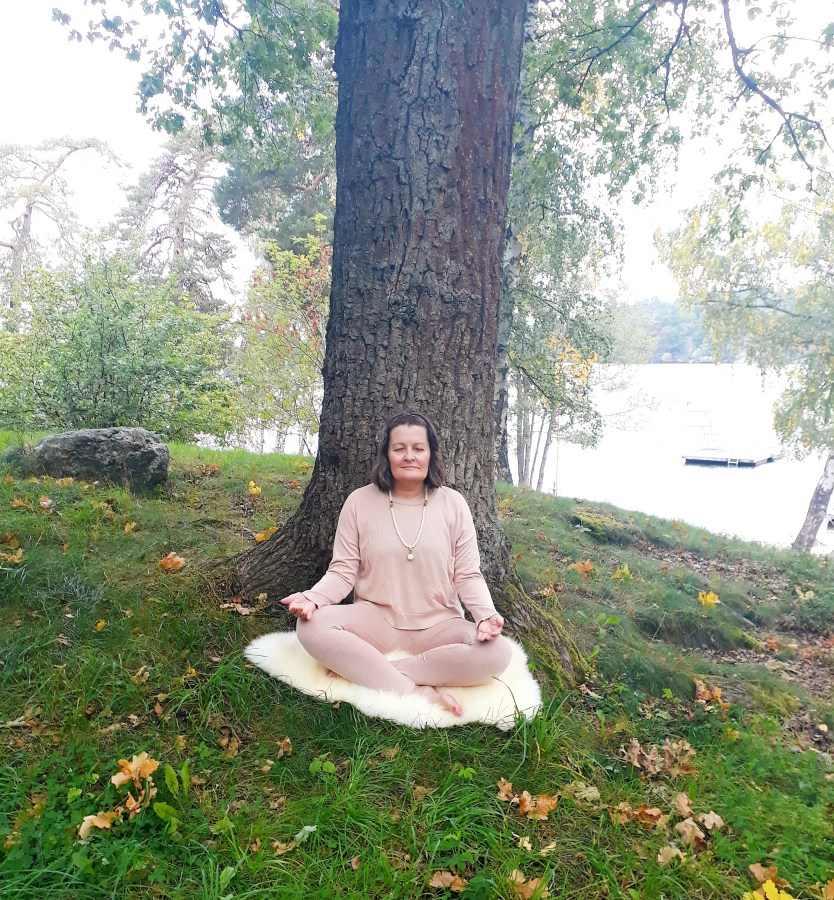
Begin by sitting down with your back straight in the lotus position. You can sit on your yoga mat or directly on the floor. You can also sit on a pillow to be more comfortable and make sure your pelvis isn’t tilting. Take a deep breath and fill your lungs. Exhale firmly. Now, begin to breathe softer and slower. Inhale through your nose and exhale
through your nose and throat chakra with your mouth closed. Repeat.

Count your breaths in fours. Inhale and count to four. Hold your breath for four counts. Exhale and count to four. Pause your breath for four counts. Inhale again and continue with this. After a while, it will become your natural way of breathing through the meditation. In the pause, you can feel stillness. Close your eyes.

Turn your focus onto your root chakra. Feel the mat or the floor underneath you, so that you are very present. Then visualize roots coming out from underneath you and into the ground. With every inhale you gather roots, with every exhale you send them deep down.

Feel your spine. Think of it as a tree trunk. Not too stiff, so it can be flexible in the wind. But not slouched either. Sit up on your sitting bones. Connect your spine with your roots.

Now open your crown chakra and visualize how your energy field right above your head, is like the crown of a tree. Feel it opening and expanding. The tree unfolding its leaves and multiplying in a green cascade.

Visualize a channel, like a straw, on top of your crown, going directly up into the sun. Feel it filling up yourself with light and letting it flood all the way into your roots. Perhaps you only feel it above yourself and the roots below yourself. This is fine. With time, when the energy flows freely through your spine, you can embody the tree. Continue to sit like this and just breathe for a while.

Take a deep breath and open your eyes again. Close with your hands together in prayer position and feel the peace. Namasté!

The inward outward journey

Most people have heard the expression “doing an inner journey”, but what does that really mean? First we travel inwards. This simply means focusing on what your inner world is about – your thoughts, your emotions, your memories and their meaning, your ideas, and your dreams. What we dream at night, is often our subconscious trying to process our impressions of the day, but also sometimes telling us things that needs to be brought to the surface for us to deal with. Perhaps a fear, a problem, we’ve tried to hide underneath the proverbial rug, or even a message from the spirit world. It’s said that our souls come lose during our sleep, and can meet with others, in our collective consciousness and from there carry with it information and inspiration. These things, can be realized, when we do an inward journey, such as through meditation and/or journaling.

What’s not so often talked about though, is the outward journey. We talk with others the same way we usually do. Sometimes, we even talk about the same things, and in the same way, regardless of who we are talking to, where, and when. That usually means we’re stuck in a thought pattern or dealing with an upset, or even assumed that we are, others expecting us to be and communicate a certain way, not at all congruent with our current state of mind and heart. However, looking inward before expressing ourselves, can enable a true blossoming. When we take what we’ve found within, and share it consciously, a door opens to new discoveries and a more deep understanding of both ourselves, others, and our world. And to dare share this, is where we mold ourselves into a constant evolving being. We can try our findings with others, which either makes us solidify our own insights, or let us develop them further, with others’ input. To dare take in others’ perspectives, as well as to dare share our own, from within our authentic self, is what enables a true exchange, free from pretences. And through this, we set ourselves free and can expand.

What are your true gems? What’s an inner longing or need you have? What’s an insight you’ve made about something you’ve been pondering about? What happens when you speak this out loud with people you can trust showing you respect?

The healing sound of mantras

Prayers have been part of many religions and cultural practices since the beginning of time. Singing together as part of worship and community, can also be referred to as Kirtan, when made interfaith and intercultural. Chanting is one of the forms.

In Hawaii, they’re called ‘oli and pule, which are a way of chanting a story and praise their gods and godesses. The chanting sounds, are made by placing the vowels in the back of the mouth to invoke a vibration, that in turn is said to have healing properties by stimulating various parts of the mouth, which I was introduced to by Kumu Jared Kukaho’omalu Souza in 2005, and have continued practicing on occasion, such as E Ho Mai, a request to be granted wisdom from above (as chanted here).

In India, there are several mantras that are part of Yoga and Hinduism. Many are made to ask for blessings from the Hindu gods and goddesses. Here is the Gayatri mantra, that I learned in 2008 through the Indian teacher Shajesh Paparali, who found me in the online forum “The Daily Om”. The Gayatri is an invocation of the Divine Light for the highest good.

In Japan, their Buddhist traditions include a way of meditating and chanting Nam Myoho Renge Kyo, which is a joint wishing well, which I practiced in the south of Sweden with an international group in 2009 (as chanted here).

In Tibet, the Mahakala is chanted to invoke protection, which I have done in Stockholm some years ago, as part of the Buddhist centre here.

The question then is, what do Christians do? Are there old Christian chants too? I think the Catholic priests’ way of praising and praying in Latin at Mass, could be seen as. And the way we pray Our Father there.

Would you like to try chanting a mantra?

Walking meditation

There is something comforting in hearing the sound of snow, crunch lightly, when we tread on it. It reminded me of practicing walking meditation again. Have you tried it?

This can be done both outdoors and indoors (where it might be easier) and is simply a way of walking slowly in harmony with your breath. Let each step, be in sync with your inhale, gently putting down your foot on the exhale, by rolling it from heal to toe. Inhale as you lift your other foot and move it slowly upwards and forward. Exhale again, when you put it down.

This is an awesome exercise to land into presence!