Sitting in silence

While listening to a soft voice, describing a beautiful garden for us to visualise, can be very comforting and nice, a little like listening to a bedtime story, it’s not true meditation. You can’t be fully present with yourself, while listening to someone else. Then your presence, your attention, is on the other person’s voice. I think, so called guided meditations are a form of hypnosis, that in fact takes us away from their purpose, to become centred through our breath.

At first, experiencing silence can be scary. It’s like opening the door to a vast, dark space, not knowing if we’re going to fall into the depth of nothingness. At least, that’s how it was for me. Meditating to soft instrumental music (to not give our attention and our mind to understanding lyrics) or natural sounds like ocean waves, can be a good start and support in the beginning. Through this, we can find a sense of rhythm that we can follow with our breath. Eventually though, the only thing we should have in mind is our breath. Focusing on the inhale, the exhale, letting our thoughts come and go, our emotions rise and fall, and returning to our breath. Listening to someone else, takes us away from this focus, rather than putting our focus within. To meditate, thus, is daring to listen to the silence.

Permission to shine

Today, it dawned upon me, that in English the word performing and performance, are used both when it comes to performing on stage, and in the workplace. In Swedish, we use different words to describe respectively. How does one then perform well? Can we use performing on stage, as a benchmark for becoming better employees?

There are two things that make a performance great. One, is the preparation, training, practicing, rehearsal and the energy put into it. The other thing, is being able to step into our own greatness, being bold and allowing ourselves to shine. To have that confidence, both in oneself, and in the audience, that what we’re about to show, is something welcome and useful that will be met with enough expectations for us to push through, but also as relaxing entertainment.

When I was in Swedish Junior High, I took drama classes after school and took part in several plays, dance-recitals and musicals. A couple of times, I got to sing solo, within character. This is much more easy for me, than to sing as myself. Nonetheless, I can remember the first time I heard my own voice in the microphone. It was as if it became so much clearer and more distinct, besides louder, it almost didn’t sound like me. It was a bit intimidating. But not because it was so bad, but because I wasn’t sure if I could step up to meet that greatness. (I guess you can refer this as an upper limit problem.)

Later in life, I’ve sometimes continued to take a step back, or tried to not outshine anyone, especially prevalent in the Swedish culture, which has just made my performance lesser. To whose benefit? Nobody¨s, of course. Part of this, has to do with having PTSD, where we indeed can “disappear” a little as a protection, or out of fear. On stage, I need to do the opposite – pull myself forward. This can of course, also be translated into the workplace for professions or tasks like teaching, speaking, showing and leading, which is what I also enjoy doing. Dancing again in my middle-age years, have become both lots of fun, but also a way to overcome this for work.

Performance off stage, and not in the spotlight, also means to do our best, to really try, and to meet others for a collaborative effort. This is to realise our true potential and the goal for lifecoaching.

What is green health?

A bite of an organic and locally produced apple. Choosing an energy provider that only use natural resources like wind and waterpower. And enjoying nature with respect, in relation to, and as inspiration.

Green health, is a strive to always prioritize our health before everything else. A strive to bear in mind both our own health on all levels: physical, spiritual, mental and heart, as well as the health of others, and the health of our planet.

One way to develop practicing this, is on the job. Are your job, contributing to the environmental issues and problems, or the solution? A simple thing like using your own brought tea-mug, instead of paper cups, is a good start. On a larger scale, how you serve your customers, can also be made eco-friendly whenever possible. The ban of plastic bags became a huge step towards this. Just like using fabric masks during Covid, whenever possible. Remembering the progress we’ve already made, makes for a more positive belief in what is possible to improve.

Another way to honor nature, is through our exercises. When we dance, practice qigong, meditation and yoga, we do this in harmony with nature, letting our creativity emerge from this relation. Taking responsibility as well as being genuinely grateful, helps to foster this too.

Here are three questions you can use for all your decisions:

  1. Is this choice good for my health?
  2. Is this choice good for the health of others?
  3. Is this choice good for the health of earth?

This green health lifestyle, with organic and sustainable choices when possible, is to live Telluselle Living.

Encouraging others to live their dream

There were two things, when I grew up, that helped shape my change of career to become a lifecoach: My Dad, often repeated a sadness of not being allowed and encouraged to become a photographer when he grew up, with his father saying blatantly no, but his mother buying him a camera anyway. My friend Annica, said she dreamt of becoming a pilot, when we were teenagers, but didn’t know how, since she was too short according to Swedish requirements. She pondered whether she should go to the United States instead, and become one through the US Airforce. I thought that was an awesome idea, and it has always felt great that she did.

After feeling some dissatisfaction myself, after working as a copywriter within the advertising industry in Sweden in the 90’s, I wished I had someone who could help me create clarity on how to change career, but still keep and use my acquired knowledge and experience. That’s when I decided to become that person myself: a lifecoach.

I started by creating a business plan within a course for cultural entrepreneurs and soon continued by getting myself thoroughly educated, to get a better understanding of society, organizations and leaders, inspired by the Lifemakeover series on the Oprah show. My exam paper for my Master’s degree in Workscience, became the foundation for another course at the university; a practical and theoretical class in Professional conversation technique with coaching and mentoring. I’ve also had a great mentor in advertising, who was like a coach to me, that I have learned my approach from.

I believe that if we encourage each other to pursue our dreams and passions, we become happier and thus better at contributing our best to society. This way, we all win.

If you’d like to try becoming coached, you can find accredited coaches through International Coaching Federation or contact me for your first complimentary session through Zoom, or in person.

The power of nature

One of the common things in folklore, whether Hawaiian, Nordic or Greek, is the belief in demi-gods that have power, and must be obeyed and made offerings to. In order to reconcile this with my fairly new Christian path, I’ve taken an interest in analysing what the common ground is, and how this can be translated into modern time.

Behind each demi-god, stands a natural power: A natural element. It can be gods or godesses of the ocean, the wind, the thunder or the fire, for example. While these indeed hold much power that humans can’t tame, at least not completely, it’s easy to see how they must have invoked great fear in humans. I think, this is why these powers became dressed into gods. For me, personally, setting God above all and having Him as the highest Master, takes away all such fears, and even the New Age-seeking. However, dancing the story of these legends doesn’t mean that we worship the natural elements per say. Just like practising Qigong and Feng Shui based on Chinese Medicine, are tools to better tend to ourselves in harmony with nature, so that we can have a better health and be more loving. It doesn’t mean that we worship the natural elements.

Now that we’ve had a rare solar eclipse, the internet has been flooded with both prophecies and medium like interpretations, said to be channelled with important messages from the Divine. As with so many other things, what we believe is what we’ll see and experience. I don’t believe it to be any signs of doomsday or that I would become affected by it in my pursuit of building this business, sell my books, coach and dance at all, more than that spring is always a time for renewal and rebirth, a time for positive action. And today, I feel grounded and happy that the sun is shining with an increased spring warmth in Sweden. What I can do, however, is to understand the solar eclipse as a metaphor of not obstructing the sun, meaning to not obstruct other people’s light, which is what I feel others in Sweden have done against me for many years. I believe, that rather helping others to shine, is a good way to share the light, as well as doing so ourselves.

Coaching through change

One of the most common expressions, when it comes to lifecoaching, is the prompt to get out of your comfort zone. But what do we really mean by that, and why do we have one?

We tend to feel safer with everything familiar. It can be a simple thing like knowing your way around your neighbourhood, making it possible for you to relax, when you’re out walking. Moving elsewhere, creates stress in the beginning, until you become familiar again with your new surroundings. It’s the same for breaking free from our comfort zone. We need to dare to move into a new area, also in our lives. This can for example mean to change your job, or break up with your spouse. Alas, this is also true for our relationships.

We often find ourselves in a role within our relationships, that makes us behave a certain way. It can be something positive like taking the initiative and lead. Or it can be something negative, like always complaining about the same thing. However, to keep a sense of safety, both you and those you surround yourself with, like to keep it the same, even if you want to try another way. Staying the same, makes us feel more comfortable. At least, that is what we think. Unfortunately, this is also true for people with addictions or a history of abuse. How often have you not wondered why a child to an alcoholic, ends up marrying someone who also is? This is why. The familiarity, lures us to believe we’re safe.

To understand this, is a necessity to understand how to change. When we change our behaviour, we’re either provoking others to change theirs too, or stirring up conflicts in an effort to make resistance to our desired change. Therefore, it’s very beneficial to surround yourself with people who are like you want to be, who might already have achieved a similar goal to yours, or simply have found their own sense of identity, resembling what you’re growing into.

Ready to expand beyond your comfort zone? A series of sessions with a lifecoach, can help you explore, and design, a plan for you to do that.

Do not disturb

Do you ever feel interrupted, when you receive a text, e-mail, or a notification? As a writer, there is nothing more frustrating than losing your train of thought, due to someone else’s interruption about something else. In fact, it can be a great stressor, to always have to take consideration of others and reply to their needs, while neglecting your own. To curb this, I’ve found two things that helps, when planning your days:

Turn off all notifications: No comments, likes, replies, suggestions or new followers, are more important than your own time and life. Whether you’re studying, working or sleeping, practicing, socialising or creating something of your own, you must prioritize this. Our lives are not online, they’re physical manifestations that we sometimes share snippets about online. Notice how you feel, when you live uninterrupted. The topic you’re discussing will be there tomorrow too. Instead, designate time slots to be online.

Keep your planned order: Regardless of the time of day, another thing you can do to eliminate stress and better manage your energy, is to decide in which order you’re going to do things and then do that. I like to have breakfast before reading my e-mails, so I can feel grounded and awake, when I’m on the receiving end of others’ communication, as well as my own. When we let our clock-time dictate our lives, we can feel more stressed. Letting it guide us, is of course important, but not more than getting things done. Another thing to be aware of, is to book your own appointments, rather than always accepting, when others think you should come.

By making active choices, you can better take charge of your time. It’s your most precious asset!

Finding forgiveness

Forgiveness works in three ways and all three must be considered, to complete the circle and be able to truly let go and move on. Here are the three ways:

Self-forgiveness: Forgiving yourself, can sometimes be harder than another person. It’s also more necessary, since you still have to live with yourself and be able to continue forward. So, try to locate within, where your offense is stemming from and why. Then, practice self-compassion. If you did your best, you can’t expect yourself to do more, until you learn more, and have the space to change.

Forgiving others: We all need to receive an apology from time to time, and it might be the hardest thing to ask for one. However, holding a grudge will certainly affect your relationship regardless of its nature, wherefore this is necessary. Simply, share how you feel. A good way to find forgiveness in terms of what others have done to you, is by putting yourself in their shoes for a minute. What have they, or are they, going through? What are their needs? What did you do to provoke the situation yourself? Also here, practice compassion.

Offering an apology yourself: Owning your own behaviour and communication, feels much more empowering than not. Try it! Look into what your motive and shape of the day was. Have you not slept enough or eaten, when you had an argument? Did you believe something negative and expecting that, or assuming something unfounded? Find compassion for both yourself and the other.

The way to forgive, can be done by relating one’s own behaviour with another’s. Let’s say that someone shows envy of you and you feel offended, since you worked really hard to get what you wanted. Instead of merely defending yourself, you can try another approach. Can you find another time, with the same person, or someone else completely, where you, yourself, have felt envious? Then, you can relate to that feeling. To heal this, offer an apology to that person, whether literally or through a prayer. This way, you can heal both backwards and forwards, including within your lineage as you set out to also include your ancestors and children and offer forgiveness also on behalf of them. This is the way of Ho’oponopono – the Hawaiian forgiveness process and prayer. When you take responsibility for your own behaviour, that you have showed in the past, you heal the future.

Everybody can be a resource

The way we look at others, often defines how we treat them. This in turn can easily become a self-fulfilling prophecy, where we seek to validate our own bias, prejudice and simply view. This has been proven through a series of studies made by McGregor, who found that when leaders believed more in their employees’ abilities, they seemed to perform better and showed more autonomy and creativity. Likewise, when managers didn’t, those employees tended to make more mistakes and perform less well. McGregor referred to this, as Theory X vs Theory Y. Since we’re all interdependent, we need to have this in mind, so we all can help each other to blossom, starting with your own view of yourself. You can be a resource!

Being a resource is, being willing to contribute with your time, skills, knowledge, creativity, problem solving, money, experiences, people skills, personality traits, voice and will. Knowing that you have this within you, is the first step. And your combination is most certainly unique. Acknowledge this!

Then, you can make an inventory, either by assessing this on your own, or together with a lifecoach. Write down what you like doing and what you’re good at. This can be things like working independently and doing oral presentations, or it can be taking care of customers and cleaning. You can find this, by exemplifying what you have done and learned throughout your work experiences, as well as during internships, volunteering and your education. Perhaps, you have a favourite pastime that includes leadership skills or artistry. These are valuable assets you own, that you need to cultivate and use.

After having this in front of you, you can ask what you can do with it. Where could these resources be used and for whom? Who would benefit learning from you? Or using you, to produce or serve others? Make a list of prospective employers and contact them! You can also try to find a mentor, who already works with something you’d like to, and learn about his or her way to get there.

Last but not least. Whenever you encounter someone you don’t particularly like, or get into an argument with – try to find something positive about him or her. What can he or she contribute with? What can you learn from him or her? And how can he or she help you?

You can read more about Theory X and Theory Y here.

The practice as its own reward

Every time I’ve practiced Isadora Duncan dance for more than an hour, I feel so refreshed! I feel I have more space, more time, and more freedom to create. I can for example, work more focused with my translation assignment, and write with more flow. It’s like an expansion within, that I can’t explain without saying that it’s also a practice for my soul, and a liberation of my mind.

While I’m dancing, I can also at times, feel joy spring forth. Then this, becomes its own reward.

Our reward, is what most often motivates us. We want to receive something in return for our effort. Usually, money is our greatest motivating factor. When we work, we do this to pay our bills and survive, but this most always includes stress, which in turn might have a negative effect on our performance, leading us to struggle even more. And while we all need money, and this is the most common reward and driver, having your passion as your favorite pastime, enables you to receive another reward, gratifying beyond the material. What is that for you? What brings you joy, that you can do, without making money on it? Lifecoaching can help you find out.

How to become more creative

Creativity seems to be high commodity these days, when so many strive to create content. Creativity derives from two driving forces: To survive and to self-actualize. Man invented how to start a fire, so we could survive the cold and cook food. Man also created art, to share with the world, to share himself and to communicate. This takes us into what creativity is.

Creativity can be narrowed down to two things: To do something completely new and unique, which is what most creative pursuits aim to. Or, to do a new combination, adjustment, or interpretation, of something already existing. Both are protected by laws of copyright.

Creativity can most often be exemplified through the arts (music, song, paintings, drawings, movies, dance choreographies, poetry, authors, design and so forth) or through the crafts (carpentry, painting, photography, architecture, recipes, clothing design, art direction, copywriting, styling and so forth). What it’s all about, is making something. What can you make? What would you like to make? What is your purpose with it? To have fun, to express your soul, to explore a technique, to sell something?

Creativity can also be innovating; a method, an invention, a solution, or even forming a new theory.

How do you then become more creative? Also here, there are two ways, which best works in combination:

  1. Through research – by watching and trying what already has been made and learning from it, by interacting with users and makers, you can detect a need for improvement, a perspective or an essence that can be cultivated and expressed anew. For example by comparisons and looking at it from an opposite point of view.
  2. Through inspiration – by faith as a co-creator, often with nature as your guide, some ideas simply appear on their own, especially when we have a real need and feel rested. Using sexual energy, can also aid to produce creative results.

It’s said, that we’re naturally creative as children, at least until the age of 6, when our societal conditioning starts chipping away at our free and inhibited expressions. There was once an experiment showing this. Six year olds were asked to draw a fire-truck. Some drew big, others small. Some drew it with one big wheel, and some with five wheels, and all in different colors. Seven year olds, were then asked to do the same thing, whereupon the majority of the group simply drew replicas of an actual fire-truck. Creativity is most often a means for play and interaction among children, which is why it’s so important to nurture our inner child, also as a grown-up, so we can keep this joyful and life-giving ability.

Would you like to increase your creativity, and try to pursue this whether through taking up a hobby, on your job, or as a new career? This is part of my coaching, that you can receive through a series of sessions, in person or through Zoom. And this will also be tried in small groups at Telluselle Living Center, with brainstorming, discussions and developing various definitions and possible solutions.
My green journey

I was always the one helping my mother to repot our plants, growing up. I liked taking out weeds in our garden and raking the yard. Growing up in the 80’s in Sweden, was also when the environmental movement took root. We started recycling paper and cardboard, and my brother recycled bottles for coins in return. We also started using less toxic detergents, that my mother loved to curb our allergies and sensitivities with. Besides this and caring for my bunny, I loved horseback riding and enjoyed our little hikes in the forest. I dreamt of being able to ride like a Native American Indian and wanted to be a Shaman, the way my grandfather had a drawing with, on his wall, that I later inherited. I often felt one with the horse, and read two books about horse psychology in an effort to become like the Horse Whisperer. We never threw trash on the ground and while I was still a teenager, I did feel certain that voting no against nuclear power plants would be the best option for our future. My future. We lived close by one, for a while, close enough to remember the drills with our phones ringing to warn us of any leaks in preparation. I felt one with nature.

In the 90’s, I worked for TetraPak as a mail-runner and after continuing to take my first year in Communication and Media basics, I got to intern at their information department, as their first one. One afternoon, I got to join them for a meeting at a remote location, filled with acres of peat, cultivating for years into becoming organic soil. A soil, I still use, for all my plants. No wonder then, that I also used recycled paper for my invoices and to my first set of business cards, as a freelancing copywriter! Raw and light brown, with a logo in green. I also became a vegetarian and started to eat organic. And went to San Francisco to see if I could move there, where much of the Green and Women Liberations movements had begun, but also understood it would be hard with English as my second language to pursue copywriting.

In 2004, at my first visit to Hawaii, I also visited Big Island and saw the Volcano spit her lava and how land was created. It gave me a spiritual experience that opened up for deepening my connection to earth and gain an understanding of how we must relate to the land, to really be part of the eco-system more consciously. In 2005, this cultural pursuit became solidified by learning how to dance Hula, upon West African dance. It was also now that I began to only use hair-, face-, and body-care products, made of biological ingredients. And learning more about how important the ocean also is.

In 2008, I became a member of the Green Environmental Party in Sweden, after having been loyal to WWF all my life. And I had just started to ponder, if I should pursue a political career, to work towards making green standards become the norm, when I was made homeless after having to wait for years to fix my teeth. I moved back to the United States instead and had hoped to build and start Telluselle Living Center in San Francisco in 2011, after becoming a member of Kanu Hawaii and getting a tip from one of their founders about Bamboo Living.

I had no idea, that living healthy and eco-friendly with a spiritual touch, would ever be considered something politically inflammable, that has become something to overcome first. But luckily, after beginning to learn how to dance the Isadora Duncan style and understanding how this cultural activist of her time, also started off her creativity by dancing in nature, it has enabled me to add an important piece to the puzzle. Isadora was of course, born in San Francisco, letting me come full circle, with a focus on creating a sustainable society through the arts.

The history of 5rhythms

Just like Isadora Duncan, Gabrielle Roth was also born in San Francisco. She overcame a knee injury and an anorectic self-consciousness, by finding a connection to wholeness, through movement. Turning inwardly rather than staring down oneself in the mirrors. She established her practice in the early 1970’s and took it to New York and the rest of the world. Gabrielle defined her dance practice as The Wave; going from Flowing, Staccato and Chaos to Lyrical and Stillness, that can be translated into the five natural elements. These are a perfect combination to also explore our emotions, ranging from fear and anger, to joy and compassion, as well as ways of surrendering through improvisation. Dancing 5 rhythms is about daring to let your body lead, to let go, to simply dance the way it feels natural and needed for you, making you feel more grounded and connected.

Gabrielle Roth also incorporated the use of African dance and Yoga, to connect the fluidity and breath with various rhythms. She made several records, as well as wrote three books, to teach us to Sweat our prayers. She was inspired by Shamanism and the desire to heal.

The 5rhythms and Ecstatic dance, suits all people wanting to liberate themselves through spontaneous movement, going through the whole body. Have you tried it?

Becoming an eco-friend

You don’t need to be neither a vegan, nor a climate change activist, to be a true eco-friend. To live a genuin green lifestyle, simply embrace indigenous values to be in relation to the land. To be part of the eco-system and have care in mind, for all your decisions. This can look like:

Green care for your body: Use skincare, haircare and facial care products that are organic at least, and preferably with only biological content (ie no parabens and un-necessary lather agents). It also means to eat organic food when possible, (ie without pesticides and chemical fertilizers), drink clean water and exercise in moderation, as well as taking walks in nature. Dress in natural fibers, and see if there are organic options when you buy clothes.

Green care for your home: Use detergents and cleaning products that aren’t harmful for the environment. Use less plastic ware and more glass, reuse when possible, recycle bottles and lessen waste (ie donate to flea markets and the Salvation Army, if not possible to sell through vintage stores or e-bay). Find balance in how much you have and how you decorate, for example through Feng Shui. And buy your energy from a company that uses wind, water or solar.

Green care for your work: Whether it’s buying eco-friendly paper to your printer, or making decisions about manufacturing, distribution and customer care, have the environment in mind. What is good for the environment can never be unhealthy or bad for anyone. Commute rather than drive, and if possible, drive together with others to lessen traffic.

Green care for your mind: Practice mindfulness and meditation to make space for good decisions and peace of mind. Wellness practices like qigong can help you focus and become more aware of your body, your emotional state and your needs. Study and read up on what sustainability and organic means, so you can make informed choices. Look at the list of ingredients.

Green care for your heart: Make your relationships green. When you go out to lunch or for a cup of coffee, see if you can choose restaurants and other establishments, that have an eco-friendly policy, such as bring your own cup, bottle or thermos. Delve into topics that relate to creating green solutions together.

Green care for your spirit: Remember that we all share breath and that we are part of nature. That this aliveness, is a foundation to feel one with and awe for. We are not separate from nature, we are made of water just like the oceans. Let nature inspire you and see how much around you in society, is inspired by nature. Celebrate its beauty and your connection through art, like dancing Hula, Isadora Duncan, West African or the 5 rhythms.

Green care for the earth: Don’t litter outside! Have a look around where you live to see how nature is shifting according to seasons. Where does the sun rise and set? When do the leaves turn red in the fall or when is it season for tsunamis? Are there places you know of that needs protection? Recognize all the animals and enjoy the scenery. This is what you want to keep and to show future generations.

The question we must collectively answer is: How do we choose between locally produced but not organic, and globally produced and organic, but more expensive to ship and through transportation still bad for the environment? Can we make organic, the standard?

The history of Hawaiian Hula

Since the Hawaiian language from the beginning only was oral and not written, everything was shared though storytelling, chants, songs and dances. Hawaiian Hula depicts the various places of the islands, the history of battles and kings, the love for one another, and the spiritual facets of the traditional beliefs and legends. Thus, Hula is a form of storytelling to music. When the white settlers came to the islands, Hula was banned for some years, but thanks to King Kalakaua, it was reclaimed and are now even part of church services at times.

There are many forms of Hula, where the two major kinds are called Hula ‘Auana; modern, danced to the ukulele, and Hula Kahiko; old, danced to the ‘Ipu Heke, a gourd drum. The focus of Hula lies in the motions of the hands and the hips, with bent knees, but one creates beauty through the dance and one’s character living righteous (pono) and in compassion and generosity (aloha) rather than just seeking it by looks. Even so, certain type of dresses and skirts goes with certain type of songs and places, as well as the choice of colors, and types of flower-garlands (leis). The best hula is a communication that forwards the meaning through spirit and the dancer, to the audience, becoming one. Most often, men dance separately from women, with a variation of steps.

To become a Kumu Hula; a teacher, one has to train extensively with someone who already is, often through one’s family lineage, and be initiated through proper protocol and evaluation. At Telluselle Living Center, we will only have Hawaiian Kumus teaching Hula.

Photo borrowed from Wikipedia.

The history of African dance

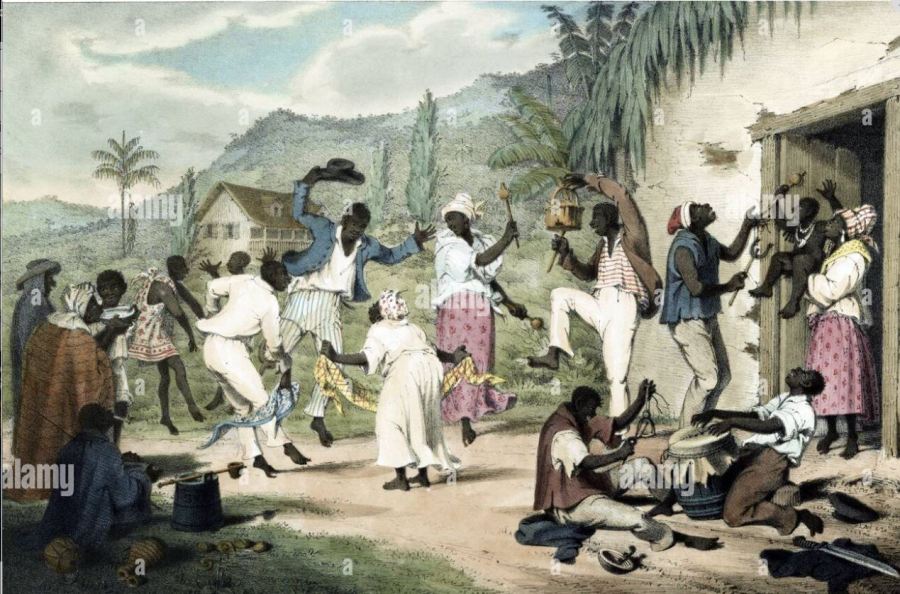
African dance, is a form of barefoot dance, expressed to live drummers. Whether to celebrate a rite of passage or a harvest, African dance motions aim to depict these, in harmony with nature. In the United States, these type of dances were brought into the country by the slaves, who used it both to socialize among themselves, as well as to liberate their bodies after hard labor. Each country has their own rhythms, some even can be attributed to a certain village, and they’re not as simple as we’re used to, using the count of eight or three, but more eclectic. Women and men can both dance separately and together, depending on the occasion. Much of the modern music, such as jazz and soul, have their roots in African rhythms. They must be experienced!

At Telluselle Living Center, there will be West African dance classes.

Photo of a painting, borrowed from Alamy.

The history of Isadora Duncan dance

As a brief introduction, I thought I’d share some more about what Isadora Duncan dance is. Isadora Duncan was a pioneer in modern dance in the early 1900´s. She thought of classical ballet as too uptight, with constricting clothing and motions not natural to the body and therefore created her own, beginning outside in nature as a child. She came to develop various sets of choreographies depicting a certain theme or era, such as the dances about love in lyrical style, dances about motherhood, dances based on Greek myths and the Olympics, and dances about Russian workers. All to classical music, preferably played by a live pianist. Her motions often contain an element of spirituality and a desire to express her soul, in harmony with nature.

This is a photo I saw in a magazine lately, showing a painting by Prospero Piatti, that the Greek Olympics also had a variation called the Heraean games, where women competed in honor of Goddess Hera (the wife of Dionysus); a must inspiration for Isadora!

She formed her own dance company called the Isadorables, performed in many European countries after she left the United States, where she was born. She died tragically in a car accident, where her scarf got caught and strangled her. The work of Isadora Duncan lives on through her dancers, that in turn became teachers to others, and further down the generations.

Feeling the time

Today, when I woke up, I guessed the time and when checking my phone, it was exactly that on the dot. I love having this ability! It’s how I feel in tune with nature and the course of life. I used to practice this with the sun, which in Hawaii is fairly easy, given the daylight stays almost constant throughout the year. But, what about the very cloudy and dark days in Sweden, then? Like today, it’s both foggy and cloudy and the sun is nowhere to be seen….

In Portugal, I learned that this feeling can also come with the shift of the tide, that too can be perceived physically. If you think about it, since we’re made of mostly water, it’s no wonder we’re in tune also with the water levels on the planet.

How is it where you live? Can you look out the window and tell what time it is? Have it a go!

Photo from Sao Joao de Estoril, in Portugal.

Loveliness

In Sweden, we call St Valentine’s Day for All Hearts’ Day. It’s a name I like. While celebrating a Saint is one thing, celebrating love in general, is far more important. So, what better day than today, to remind ourselves of the many kinds of love we have:

Romantic love (for sensual partnership)

Friendship love (for fun, for trust and for support)

Family love (to be fully known)

Classmates love (for growing together in knowledge)

Co-workers love (for respect, accomplishments and mentoring)

Pet love (for unconditional attention and touch)

Nature love (for beauty, oneness and belonging)

Human to human love (for compassion and empathy)

Divine love (for Agape and beling loved by God)

Self-love (for protecting ourselves and have good health)

The most crucial thing that I live by, is focusing rather on being loving, ie to love, rather than worrying about who I’m loved by. I also try to remember that we can’t receive all types of validation from the same person. Therefore, it’s more important, how many I can love.

What is a good dialogue?

We post on social media, text each other, and chat. We listen to webinars about prosperity and watch teachers talk about how to find bliss and success. But nowhere, seems there to be any real dialogues. No actual replies based on your specific situation, conditions or concern. This is my specialty as a lifecoach, whether for one-on-one sessions or for small groups (up to a dozen). The absolute prerequisite to holding an authentic dialogue, is assuming a genuine stance of respect, honesty and equality, with an open mind, and a willingness to let the conversation flow and develop on its own.

Typically, we decide a time and place beforehand, where a level of confidentiality can be held, and with a set agenda, ie a decided topic or issue to discuss. This isn’t to prepare some kind of oral examination, it’s more to have an agreed upon focus for our dialogue. A topic can be a special situation, relationship, or problem in need of solving, or it can be an exploration and discovery of various themes, that we want to define and find coherence for together. The whole purpose of a dialogue, is to listen and clarify things, where the answer you give, leads to the next question becoming posed by the coach. The result is a solution, or conclusion, coming from yourself with a more varied perspective and will to act on. Contact me to try! The first session is for free.