The other day, I came across a woman named Emma Marshall on Instagram, who recently has published a thesis about how dance is medicine, also with rave. When I did yoga in the beginning of 2000’s and studied at Malmö University, I wasn’t taking any dance classes, but often was out clubbing, and realized this through my own experience as well, since I rarely even drink and never do drugs, but can get high on the dancing itself. This in turn led me to begin with WestAfrican dance in 2004, whereupon I was introduced to Hawaiian Hula in 2005, and then reconnecting with regular dance classes in Jazz and Modern in 2006 and onward. Here you can take part of Emma’s story on Ted, with which I truly can relate:
And you can find more about Emma on her webpage here.
This revelation about the benefits and similarities to shamanic practices with rave and clubbing, is also the foundation of Ecstatic dancing, and why I think it’s important to also offer at Telluselle Living Center, as an alternative to choreographically led classes.
By moving our bodies, we free our minds and release stress.
A couple of days ago, I had planned on participating in a webinar about AI in coaching, through Zoom, when I found myself running late and in need to eat. I decided to eat in front of my computer in the kitchen, with the camera off meanwhile, and then resume, which I did. But, I became so stressed!
Many years ago, I used to eat in front of the TV, sometimes. I’m pretty sure, many others do too (or the phone). However, I stopped doing so, to not have to ingest, and digest, anything else but the food, as well as practicing being more present. And, I’m so glad I have. The stress of doing two things at once, having your attention on two different things at the same time, is completely un-necessary to provoke ourselves. It’s one thing, that life may produce those moments, but we for sure don’t need to seek them. This also made me realize how much more calm and at peace I am nowadays. Something I’d never would want to trade. I’m also much more focused and efficient (when I’m not being stalked).
We seldom know how stressed we are, until we no longer are. How is your level? What can you do to make it less?
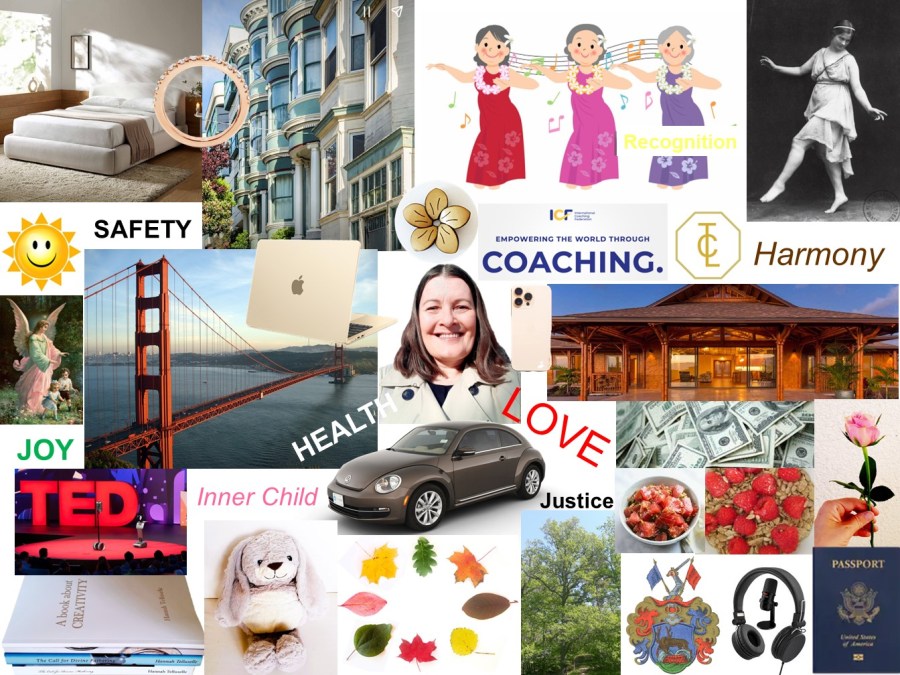
I’ve made a new vision board! It’s been almost ten years ago, since I made my last one, but a couple of nights ago, I felt this inspiration coming back and decided to make one directly on my computer, all digital. Normally in life coaching, vision boards are made of cuttings from various magazines and papers that you assemble into a collage, with the added variable of becoming a journey of discovery, so that you can see what you’re being drawn to and need in your life. However, if you feel sure about what you like having, and would like to have, you can do it this way too. I did mine in Powerpoint and it took about three hours. You can also collect clippings, or images, for a while first.
In the middle, place a photo of you. Then, simply gather photos that you already have, or gently download those things that you either want literally, or that symbolize what you want. You can then add various words that are important to you. This now becomes a visualization – a vision – of what you are going to attract and manifest. Look at it regularly, to remind you, and help you keep focused on your goals. Then leave it, from time to time, and later see what you actually did attract into your life! You’ll be amazed!
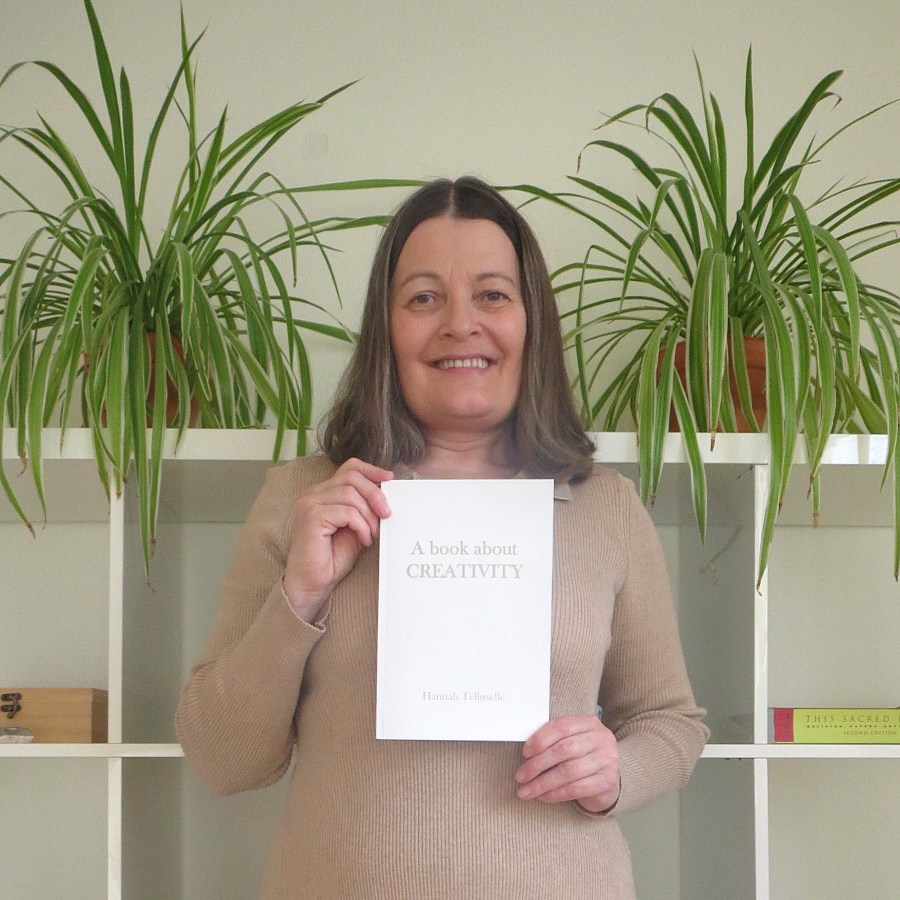
I’ve written a little book about creativity, where I share my experiences and tips on how to become more creative. Here is the description:
What is the new Creator Economy and how can you be part of it? Copywriter and Lifecoach Hannah Telluselle, takes you through the basics in A book about Creativity. Here you’ll learn what defines true creativity, whether it’s art, an invention, or an innovative method. She shares tips about how to make up ideas, which type of professions you can seek, and guides you through the creative process with coaching questions. All this enables you to become self-actualized and a co-creator of the world, where you can express your authentic self, reduce anxiety, and serve others, whether as a pastime passion or a full-time job. As a reward, you’ll feel happy and fulfilled, as an honest participant of progress in society.
If you’d like to buy it, you can find it on Amazon and Kindle here.
Most people have heard the expression “doing an inner journey”, but what does that really mean? First we travel inwards. This simply means focusing on what your inner world is about – your thoughts, your emotions, your memories and their meaning, your ideas, and your dreams. What we dream at night, is often our subconscious trying to process our impressions of the day, but also sometimes telling us things that needs to be brought to the surface for us to deal with. Perhaps a fear, a problem, we’ve tried to hide underneath the proverbial rug, or even a message from the spirit world. It’s said that our souls come lose during our sleep, and can meet with others, in our collective consciousness and from there carry with it information and inspiration. These things, can be realized, when we do an inward journey, such as through meditation and/or journaling.
What’s not so often talked about though, is the outward journey. We talk with others the same way we usually do. Sometimes, we even talk about the same things, and in the same way, regardless of who we are talking to, where, and when. That usually means we’re stuck in a thought pattern or dealing with an upset, or even assumed that we are, others expecting us to be and communicate a certain way, not at all congruent with our current state of mind and heart. However, looking inward before expressing ourselves, can enable a true blossoming. When we take what we’ve found within, and share it consciously, a door opens to new discoveries and a more deep understanding of both ourselves, others, and our world. And to dare share this, is where we mold ourselves into a constant evolving being. We can try our findings with others, which either makes us solidify our own insights, or let us develop them further, with others’ input. To dare take in others’ perspectives, as well as to dare share our own, from within our authentic self, is what enables a true exchange, free from pretences. And through this, we set ourselves free and can expand.
What are your true gems? What’s an inner longing or need you have? What’s an insight you’ve made about something you’ve been pondering about? What happens when you speak this out loud with people you can trust showing you respect?
In the mid-90’s, I had a boss named Gert-Allan Persson at the advertising agency Södergården, I worked at as an employee and later for as a freelancer. He taught me the importance of having an employee manual made, also for small businesses, and the importance of budget transparency. Every week, we started off with a meeting to delegate and follow up our campaign plans and projects, as well as the finances of the firm. How much we had been able to invoice, how much our salaries cost, and thus how many hours we needed to have completed with actual client work, to make it even. Then, we also received a small bonus, when we exceeded this. In this way, it became clear how a business is run and how my part as an employee plays in. This is something I’ve carried with me since then, as a positive example to forward and use.
At Telluselle Living Center, it therefor is necessary to be transparent with the income and the costs, so that each instructor, teacher or coach, can see for themselves what their contribution is. For example, the cost of the house can be budgeted with anything from property tax, maintenance and mortgages (unless I can find an investor or two…), to insurance and utilities. This cost is set per month, regardless. To meet this cost, it’s then easy to count how many visitors need to show up and pay for each class, and how many classes. Anything above this, and salary taxes and marketing, will be what becomes the profit for each instructor (teacher or coach), with some to me. My hope is, that this kind of transparency and model, both becomes grounded in real facts, as well as encourages leadership and responsibility for each contributor. If owned together, it will be equally divided as a co-op. The question is, whether this should be a for profit, or a non-profit, organization.
How is it for you where you work? How much business, knowledge and collaborative effort are you contributing with? Are you paid accordingly and equally?
Given the many years I’ve been online with this business plan and ideas around building an organic wellness center in bamboo (or any other sustainable material), I’m pretty sure many of you wonder why it hasn’t been built yet, at least in Sweden where I’m from and live. Here, the culture is very much to hold back, to not take initiative and to never follow a new person unless lots of others do too. Swedish people need to know you first, but nobody wants to get to know any new people, ie me, except for some international new acquaintances. My old friends, are long gone without any efforts to contact me and I’m too tired of always having to. I’ve changed, too, of course.
I began planning to build it in the south of Sweden in 2008 or so, but nobody got fired up about it. I had started working as a lifecoach in 2004, when I was finishing up my Swedish Master’s degree, but was directly put in foreclosure due to an old debt. After that, the Swedish government and public job agency adopted the profession “Job coach” and used for their procured consultants, seemingly using my first plan made for the Career center at Malmö University and developed to fit nationally. However, without my permission or participation. And with many not coaching at all. I never even become called to an interview, even though I’m the one who started it. Thereupon, I lost my home due to negligence by my social worker, who forgot to deposit my money for rent twice and thus I took more student loan and went back to Honolulu, HI. My plan was to finish my American Master’s degree and/or get a professional certificate (a year less), depending on whether or not my Swedish credits could be partly used into the degree. And then, I hoped to do an internship with my exam paper in 2011 in San Francisco and then stay there, working, and building Telluselle Living Center. To build it with bamboo, was an option I learned about in Honolulu, where I got to see a sample house and meet with the architect. However, I was deported 2012 from Honolulu, due to Hawaii Pacific University delaying the transfer of credits and not approving temporary work authorization, which otherwise was allowed on my visa.
Back in Sweden, I met with business consultants about starting a cooperative and got to know more dance teachers, that I could see myself working with, in West African, 5 rhythms and Isadora Duncan. Thus, I now looked into building it in Stockholm instead, after I had finished writing my two first books. Again, I was met with hesitancy, others waiting for others to go first. Add thereupon a heavy sales tax of 25% that needs to be added onto all prices here, making the budget quite tight and not possible due to said old low credit score.
Then in 2014, I was instead slandered, stalked, plagiarised and threatened for many years, so much that I eventually had to flee in 2018-20, first to Germany and then to Portugal, and then became locked up in a psychiatric ward due to said slander, based on fabricated and twisted around facts, made by Swedish authorities, who extradited me due to an email that others would only receive a fine and probation for. One of the psychiatrists, who gave me my first examination, claimed that I should be deemed insane for thinking that a house made of bamboo could be built in Sweden, pretending that I wouldn’t know it required isolation, which I think is so self-evident I didn’t even consider mentioning it. Nonetheless, it certainly isn’t criminal, yet I was treated like one. My body took its toll, after that 2 year “treatment” which has taken me equally long time to recuperate and recover from, with anything from dental surgeries to eye surgery to removing skin cancer and lymph nodes (and still waiting for the Supreme court to rehear my case). Hence, the many years. So, could I safely build it here in Sweden finally now? No, obviously not. Building it in Portugal, could be an option, but since I don’t speak any Portuguese, that seems not as reasonable. Which takes me back to building it in San Francisco… That is, if I can conjure up enough of an income with a work visa for starters, and get loans and investors under way in the United States, without any more stalking, slander and sabotage following me there. What do you think?
If you’d like to read more about it and how I healed my inner child to continue my path of creativity, you can read it in my book The Call for Divine Harmony – finding pearls of wisdom here.
To release tension and stress in your body, you can try getting the Hawaiian massage Lomilomi. It’s traditionally performed by a therapist using both underarms and elbows, besides hands. Likewise, it’s important to give both sides of the body equal attention, and at times with pressure diagonally, which helps to reconnect and balance our right and left sides. Some therapists, offer to say a prayer first, and together using your own breath, you can get a deeper healing experience, helping you to push through and release any built up tension that is stored in your muscles.
For me personally, it’s been very helpful to get Hawaiian Lomilomi, which has enabled me a spiritual realignment and centeredness too, that I felt especially in Lund, in the south of Sweden, where I got my first treatment in 2009, and later in Honolulu, HI 2010, and in Estoril, Portugal 2015. It’s how I became reconnected with my inner child and could let her integrate. A couple of days ago, in Stockholm, Sweden, I got myself a new treatment, which was focused primarily on my physical wellbeing. Nonetheless, it also brought back some feelings of nostalgia and relief. I believe the effect becomes more wholesome and better, with the add of ocean air and salt water, but it feels very comforting and re-assuring that Hawaiian Lomilomi can be offered throughout the world, including here in Sweden. And naturally, this is why I’d like to include this in the offerings at Telluselle Living Center.
Having had to live in closed and shared quarters for many years, now having enough space to roam in, makes the difference palpable, also internally. Not only can I practice yoga, qigong and dance warm-up at home, I can physically define areas in my apartment for rest, for work, for eating, for socializing etc. To each area, I attach, and detach, what comes with it. I can leave each at its own, and thus can be more present and more relaxed, showering it off before going to bed.
We all want to feel safe. Especially at home, in a home that we can call our own. Having one, is the foundation for getting all our needs met, as well as having room to process, plan and execute action-steps towards fulfilling our goals. This is why having one, always is a priority. Why I have had to fight for this, so many years in a country like Sweden, is very cruel.
As someone, who always seek to create and communicate, not getting my train of thought disrupted, is invaluable. Having a space to sit and write without interruption, makes it possible to keep the tone and desired way of expression much easier. It’s like the external space, also enlarges my inner space, so that I can manoeuvre and navigate my feelings, impressions and ideas much easier, which in turn makes for better decision making.
This is why I personally, use Feng Shui, and live in a simple color-coordinated harmony, free from clutter and any excess things, which means free from distractions. (This in turn, is what I seek to extend, when I build Telluselle Living Center.)
And when we feel safe, we can contribute more with our time and energy, for the benefit of others.
Think of a time, when you felt pure joy. What were the conditions like? What were you doing? And what were you thinking? By realizing this, through our own experience, we can seek to re-create it. Maybe this is even why it’s called recreation?
I’ve found that the common denominator for me, is when I’m able to lose myself in an activity and letting go of my self-consciousness. That is, when my worry for how I look, or what others will think of me, takes the back seat. Or I don’t even think about it at all! This doesn’t mean that I’m not aware of how I look, for example of my posture while practicing dance. But my focus is, in the here and now, completely. Experiencing it. It might just be so with everything that we do in deep concentration, and with an outwardly expression, which means that it’s also true when we’re immersed into a conversation, or any activity that you fancy.
It can also be when you feel victorious, such as having overcome a fear, or remembering what it was like, when you grew up and played. To experience joy, add therefore an element of play into your action – approach what you’re doing with the eyes of a bold child and have fun.
Most of us, say we want change, yet don’t do what is needed. There are various ways to look at this, and find both the motivation and the energy. First of all, the reward of changing must be greater than not, including taking action. If you’re too tired, you’re too tired and thus need rest. Then, resting is more rewarding because it feel better and is even crucial to your health. But, if you’re just feeling sluggish, you will feel better after going for a brisk walk in the forest, for example, and this feeling, is the reward of moving your body and getting fresh air. Discover what makes you feel better, is an important step.
Second, feeling frustrated or even getting into a conflict due to someone asking you to change, whether at work or privately in a relationship, can actually create the energy needed. Think of it as friction. The friction we feel when we rub our hands together, is what creates heat. And friction forces us to get out of our comfort zone and seek out action. Action that creates change.
And third, it’s natural to feel resistance. It’s scary to try something new. You might have to overcome your ego, just wanting to be in the right. Or perhaps you feel pushed into the change, by your boss or significant other. Then the best thing you can do, is to take charge by finding your own reason to change:
What can I get out of following through with this proposed change?
Will you get better paid? Become more fit? Free up time? Look better? Become seen as a hero? Grow closer and deepen a relationship? Develop a sense of being more trustworthy? Or even, finding a reason to quit altogether and not go through with someone else’s desired change, but turn it into an event you’d like to have, but with other people and elsewhere?
A lifecoach, can also help support and clarify your options. What do you need to change?
The first time, I realized that I was able to reflect in action, was on stage. Reflection in action, is a term developed by Douglas Schon, who together with Chris Argyris also developed the concept of double loop learning. Reflection in action means to be able to be so present and aware that you can catch yourself in the midst of doing something, and alter course, such as changing how you’re communicating. Performing a play or dancing on stage, can be an opportunity and a must to, such as if you lose a line or someone else does in your play, you need to be able to improvise and steer it back into the original text. The same goes for dancing, if you forget a piece of choreography, or danced a motion too fast, you have to be able to improvise and do another motion, in order to not lose flow and keep the audience entertained unbeknownst.
Translating reflection in action, to our daily lives, means to remember to be aware and present in all your interactions. Ask yourself regularly: Am I doing what I planned to? Am I doing this my preferred way, or the right way as told? Am I coming across to others in a manner I didn’t mean and can say something differently or in a different way? Being present like this, also enables our instincts and our intuition to speak more loudly.
Then we can of course also reflect on action, which means to think about what we did, said and wanted afterwards an event, situation or in a relationship. This enables us to evaluate what we’re doing so that we can understand and find our own motivation to change, and do so accordingly.
To discuss your reflections, don’t hesitate to contact your favorite lifecoach!
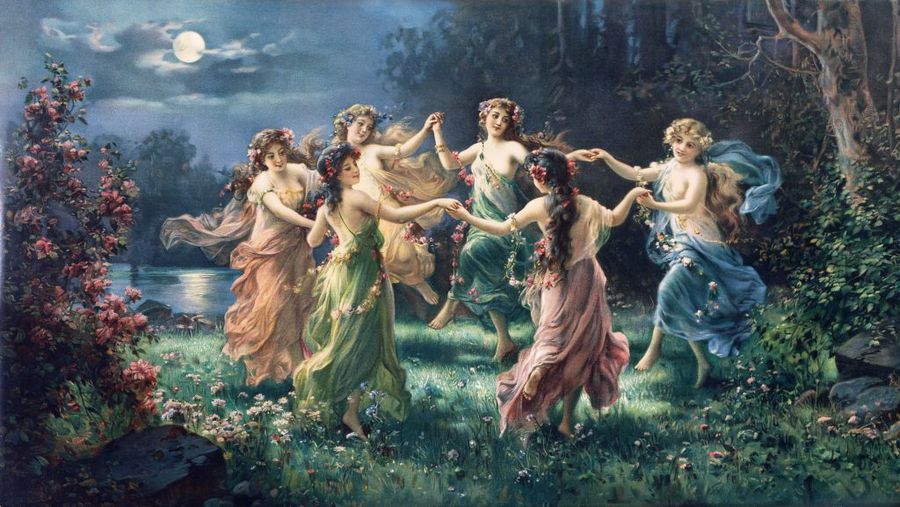
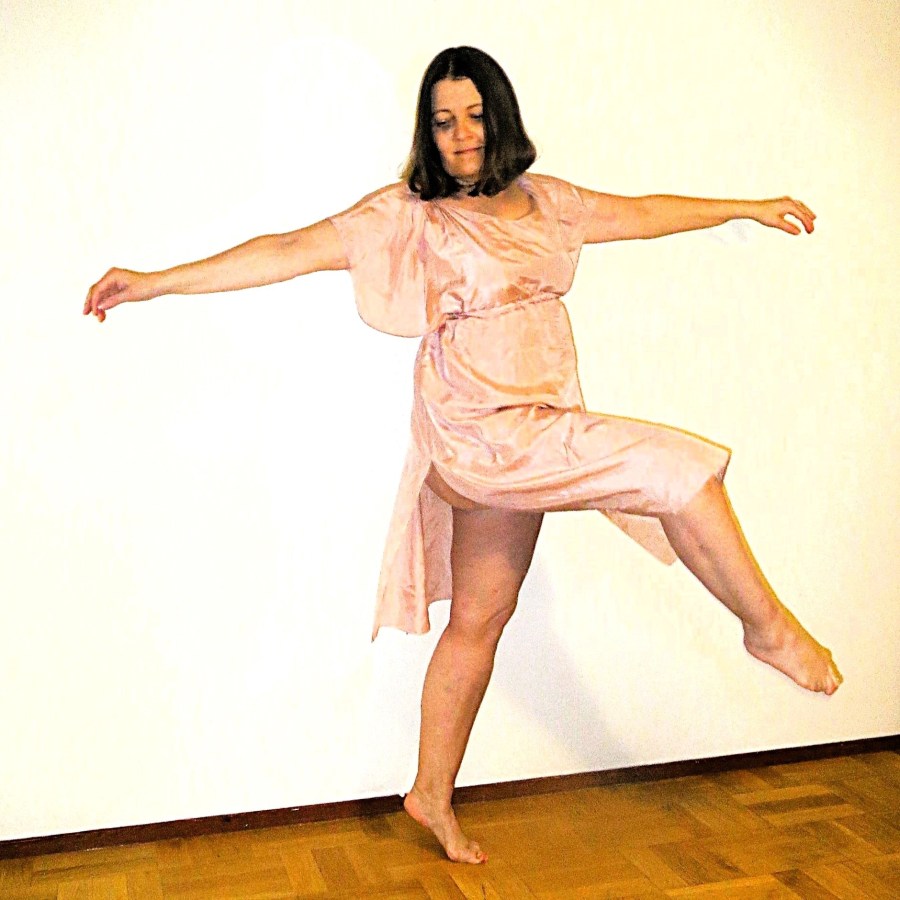
There is something enchanting about how art can inspire another art. A piece of music, can move a dancer and inspire a choreography. A dancer can inspire a painter. And a poet can inspire a musician, for example.
It’s all about one thing – capturing a motion. A motion, often originating in nature.
Like Isadora Duncan has said: “To seek in nature the fairest forms and to find the movement which expresses the soul of these forms — this is the art of the dancer.“
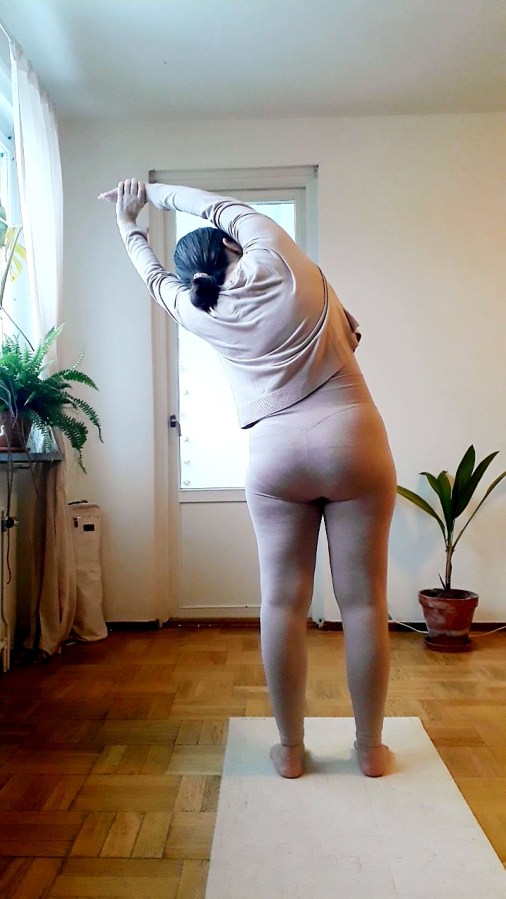
Usually, yoga is associated with being flexible and practice various asanas (motions) that help us become more flexible. But, yoga can also be used to develop strength. This is done, by holding ourselves in the position through our own resistance and discipline, while we stretch, such as in this photo. I’m stretching the sides, but keeping my hips still and facing forward, which enables me to get a focused movement on the sides, while using focused breathing. The motion becomes a dynamic between stretching and holding.
Another simple example to try, is while you stretch out the front part of your thighs by bending your knee and holding your foot behind you, try to also squeeze your butt and push it slightly forward. Can you feel the difference?
Learning to hold our positions, is what enable us to develop strength. Something that can be translated and used in life too.
For a dancer, a mirror is a must. We use them in our studios, to see that we do the motions correctly. For most people though, mirrors are often a way to find examples of your looks to complain about. The woman who tried to change all this, was called Louise Hay, and she invented something called “mirror-work” as well as affirmations. Mirror-work, is to be able to stand in front of a mirror and express that you love yourself fully and honestly. In order to get there, you can use affirmations.
Affirmations are positive statements, that you say in present tense, as if they were true already, such as: I’m beautiful. I’m worthy. I’m courageous. In the beginning, when I started using Louise Hay’s affirmations, as well as wrote my own, in the mid-90’s, I often felt like they weren’t working at all. Instead, I felt that my emotions regarding the topic, came to the surface more, whether doubt, sadness or anger. This however, enabled me to feel this emotion more fully, and delve into the cause of it. It could be something someone had said to me in a belittling way, or something else I had experienced. Some days, it was simply a lack of self-esteem. Finding faith and working through these emotions, by forgiving and reframing the incidents and conflicts from a more adult perspective, has then made it possible for me to actually feel, for example, both beautiful, worthy and courageous.
Have you ever tried using affirmations? What would you like to feel about yourself and be? How do you feel right now saying them? Why do you feel the opposite? Who and what can you forgive, including yourself?
One of the cornerstones of lifecoaching, is to set a goal and then make a plan to reach it, checking off your actions as you go. Setting a goal, isn’t something lofty, but a very precise process, that has a couple of components that are important for it to work.
Here are seven things to consider, when you set a goal, with an example. A goal has to be:
Specific – define exactly what you’d like to achieve, such as: “I’d like to lose weight.”
Measurable – define how much, or any other factor that you can measure, such as: “I’d like to lose 10 lbs.”
Attainable and Reasonable – state something as your goal, that you know you actually can reach. Don’t opt for wanting to lose 30 lbs in one week. That isn’t attainable and reasonable.
Time-bound – set a deadline for when you’d like to have reached your goal, such as: “I’d like to lose 10 lbs before June.”
Action-oriented – include something about how you intend to reach your goal, such as: “I’d like to lose 10 lbs by going for longer walks, three times per week, before June.”
Purposeful – stating why you’d like to reach your goal is important to make it feel purposeful, such as: “I’d like to lose 10 lbs, so that I’ll feel better about myself, get in better shape, and look better.”
While waiting to be able to build Telluselle Living Center, here is a practice video for now, of me dancing a classic Hawaiian Hula Christmas song at home, until a real Kumu can join:
We all want to feel connected and that we belong. Many search for a group and adopt to their culture, whether ways of talking or dressing, eating or listening to music, but it can soon become a role we play, an imposed persona with which we don’t operate from an authentic place. A pressure to conform from the outside. If we instead, meet where diversity is celebrated, and center around a cause or topic, creating goals together, we can build relationships that truly nourish and support us. All sought from inside, to match our own values.
Sometimes, it’s nice to put aside all our commitments to others, our own history and any current dramas at home, and simply focus on something else, without baring our souls. This too, can be done with authenticity, as long as we remain truthful and honest about our own values and experiences. We can for example discuss equality in the workplace, without disclosing any private information, if we don’t feel like it, but still share our own examples from work, besides our own opinions and ideas.
To really connect on a deeper level, however, we must dare to share our own struggles and how we overcame them, our own journey, our own questions and concerns, our own hopes and dreams, so that others may recognize themselves with similarity. When we found our conversations through real-life examples, it becomes increasingly more easy to find and express empathy, through which we can truly support each other, to heal and grow. Together, we can create progress and safety. And form a sense of unity based on diversity.
The sacred circles, support groups, and coaching groups, at Telluselle Living Center, is thus about storytelling with a purpose, passing a talking stick.
One of the perspectives you can use, when planning and improving your life, is the one of sustainability. The goal of living eco-friendly, is to create more sustainability. This means, that we want to design our life, in a way that can support future generations, as well as making our own last better.
Factors to consider can be:
Is my choice of profession sustainable? How is my job affecting the climate, others’, and my own health?
What is my wealth of knowledge? How can I transpire this to my own children, customers, co-workers or students?
Are my buys sustainable? My choice of power source for energy, choice of food, how I use water, fabric and style of clothes, care products, cleaning and detergents, and so forth.
What makes me feel joy? A happy person, has better health. What makes me happy?
Do I have sustainable relationships? Am I connecting from a place of authenticity? Do I care for my relationships to last?
Is my life-balance, and the use of my time and energy, sustainable? Am I pushing a lot into my schedule, or taking time to rest and reset in between?
Do I live with a purpose? What is a cause that I feel deeply for and like to support? How can what I do in life, contribute to a better society?
To talk these over, contact me for a series of life-coaching sessions. Each session lasts for an hour and costs 100 USD, either in person or through Zoom. You decide yourself for how long and how often (I recommend once every two weeks, for three months, to define and implement a change.) The first coaching session, is for free!
Part of living eco-friendly, is to develop your own relationship to the land. We do this, by connecting with nature, where we’re living. Hopefully, even if you live in a city, there is nature not too far away, like a park, a piece of forest, or a small beach by a lake. Make this into your own sanctuary, that you visit regularly. But, how do you then develop a sense of being one with nature?
Here are some tips:
Be present (don’t distract yourself with music, or even conversations)
Indulge in your senses (notice the scents, sounds and sights, touch the surface of a rock or tree)
Assume a state of wonder (marvel at the height of trees, the delicate design of leaves, colorful flowers and the beauty of it all)
Remember your place in the eco-system (which animals are below you and which are above you in the hierarchy of preys and predators)
Notice the seasons (and eat accordingly when possible)
Grow something in a garden, or a pot indoors, and tend to with care
Simply put, spend time outdoors and feel the aliveness, that you also are part of.
 TELLUSELLE LIVING CENTER