Happy Merrie Monarch Festival! Imagine a dance coming from the heart and touching yours – that is the Hawaiian Hula. And right now, the yearly Merrie Monarch Festival is in full spring in Hilo, Hawaii, where the finest and best performers compete, but also meet and keep the culture alive.
I’ve loved dancing my entire life. As a little girl, I took ballet classes and wanted to become a ballerina. When our family moved, I had to change to taking classes in jazz dance instead and continued with this for many years. As an adult, I put it aside for a while, when I was focusing on my copywriting career, but realized later that something that used to bloom inside of me, had started to wither. And that nobody should tell me to stop dancing, whether out of jealousy or envy. When my mother became terminally ill in cancer a decade later, I felt pulled to begin dancing again, and took to West African dance, remembering how I used to play with a girl and her family, part Nigerian and part Swedish when I was a little girl. The drums created rhythms my heart began to synchronize with, and I could reclaim my passion. Dancing barefoot and closer to spirit as my mother passed away in 2004, I longed for something softer to comfort me, while wondering what a true woman really should be and look like. And then… An opportunity to study in Hawaii with Swedish student loan arose!
The stunning sunsets were accompanied by a group of Hula dancers at the Waikiki beach, where I watched them in awe for many nights. I then realized, I could learn this too.
All my life as a little girl, I’ve always wanted to wear beautiful dresses and here, women wear dresses all the time, and with beautiful flowers in their long hairs! I grew long hair and started to practice Hula at the grounds of University of Hawaii, where my then Kumu Hula (Hula teacher) were studying and teaching classes in the evenings. While it took some time to relax and be grounded, I saw my future turning bright again.
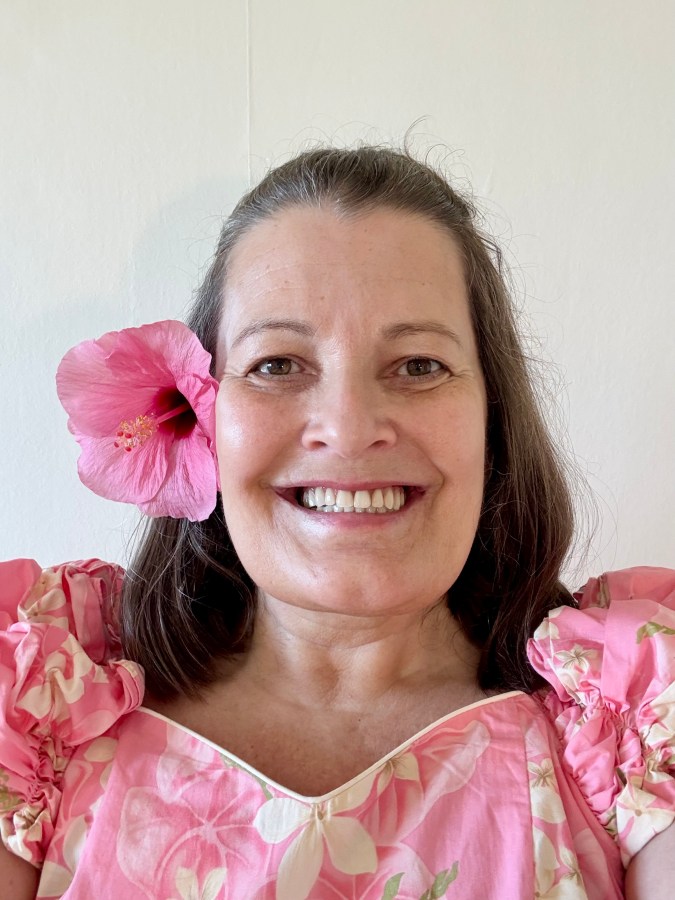
Hawaiian Hula is a set of dances in various styles, both modern and ancient, that describes the life in the islands. Back in the day, Hawaiian was only a spoken language, where the songs, chants and dances kept it alive as a way to tell the history of the islands, honoring their kings and queens, about their battles, about the places, about their relationships and about the legends and myths featuring gods and goddesses in Hawaiian folklore. For example, Pele is considered the goddess of volcanoes that Hawaiian Hula dancers chant and dance about and for. When the white missionaries came to the islands with James Cook, Hula became banned and looked upon as barbaric. It couldn’t be more far from the truth! It’s rather believed that to be a really good Hula dancer, we should be pure channels for the Divine spirit and practice Aloha, which is compassion towards ourselves and others, while caring for the land in relationship, making us into true stewards and stewardesses. Luckily, King Kalakaua reclaimed Hula as an allowed art form, and it became practiced openly again in the late 1800’s.
In 1964, Hawaii sought to improve tourism and began a festival, that in 1971 became the Merrie Monarch Festival with a yearly competition and re-enactment of King Kalakaua’s coronation with a parade through Hilo town. He is considered the merrie monarch, besides the beautiful butterflies that also live here.
Nowadays, the Merrie Monarch Festival consists of three parts: Men and Women dancing separately in the Kahiko style – a style based on chanting and drums, and in the ‘Auana style – with choreographies danced to music played on ‘ukuleles and traditional ways of singing, both in Hawaiian and in English. And a day when chosen women dance solos in both styles, to compete for the Miss Aloha Hula title.
Watching the Merrie Monarch Festival, shows us how various implements are used, like bamboo sticks (called Pu’ili), rattle gourds decorated with feathers (‘Uli’uli), stones (‘Ili’ili) and small drums (Ipu Heke or Punius). We get to see how leis and ti-leaf skirts are worn, and how dresses, shirts and skirts are matching the song and the island it comes from with their printed patterns and colors. Altogether performed with a strong sense of unity, dancing in groups as one. Each step and hand motion shows us the sentiment and the meaning of the song, together with the dancer’s facial expression. The goal is to make the motions both defined and subtle at the same time, tuning into the power of the place the song is about, where each motion also holds this energy. When Hula is performed well, it creates a connection between the audience, the music and the dancers, and with God.
To learn more about my own experience of living in Hawai’i and beginning to learn how to dance Hula, read my book The Call for Divine Mothering ~ applying the keys to paradise, available on Amazon and Kindle.
To watch the Merrie Monarch Festival, go to their website at merriemonarch.com
 TELLUSELLE LIVING CENTER